
The human race has an unrivalled fascination with the beyond. To our luck, we live in an age where science and engineering are advancing at a rate faster than ever before. Every day, ground-breaking discoveries are being published and technology is being created.
However, most can agree, the next monumental step for mankind lies beyond this planet. It lies on Mars.
Join me on a trip to the red planet.
The Journey
Your spacecraft will depart Earth at a speed of around 24,600mph and the cruise will last seven months, spanning 300 million miles of our solar system. You will have plenty of time to admire the best night skies of your life.
One thing to watch out for during this cruise will be the lack of gravity. On Earth, the acceleration due to gravity is a comfortable 9.8m/s². On your spaceship, there is none. Your body will be in a constant state of weightlessness.
This may be enjoyable and entertaining at first, however, there are several health risks to consider. Everyday tasks such as getting out of bed or lifting an object will become infinitely easier and your body will have to exert much less force than it would on Earth. Due to this, your muscles will begin to shrink or atrophy, your bones will lose calcium and become brittle and your heart weaker. To counteract the negative effects of zero-gravity, you will have to undergo a rigorous daily training schedule.
Seven months later, the dusty surface of Mars approaches and your spaceship touches down on your destination.
Where will you live?
When choosing where to live on Mars, you have to take into account the tilt of the planet. Similarly to Earth, Mars is tilted on its axis. This tilt is what gives a planet its seasons.
The southern hemisphere of Mars is pointed away from the sun at the same point at which the sun is farthest away. This means that the southern hemisphere experiences freezing winters and scorching hot summers.
A much better idea would be to set up a base somewhere in the mid-latitudes in the northern hemisphere. A year here is 1.88 Earth years, and you’ll enjoy seven months of spring, six months of summer, five months of autumn and a short four-month winter.

A year here is 1.88 Earth years, and you’ll enjoy seven months of spring, six months of summer, five months of autumn and a short four-month winter.
Mars’s Atmosphere
You will be relieved when you feel the invisible force of gravity once again weighing down on you. However, that relief might be short-lived as Mars’s gravity is only 3.72m/s² (0.375 that of Earth). The long-term effects of low gravity on the human body are still relatively unknown. You may also have to re-learn fast movements such as running and jumping.
The average temperature on the surface of Mars is -60 degrees Celsius, with max temperatures of around 20 degrees in the summer and as low as -126 degrees in the winter. The diurnal temperature variations are also very large and can sometimes cause massive dust storms. These can be so big that they cover the entire planet! As scary as this sounds, it actually poses very little risk to you. Mars’s atmosphere has exceptionally low pressure, meaning that these epic dust storms will feel like nothing more than a light breeze.
On the topic of Mars’s atmospheric pressure, the air is 100 times thinner than on Earth and is mainly composed of carbon dioxide. This means you won’t be able to breathe the fresh air outside your base.
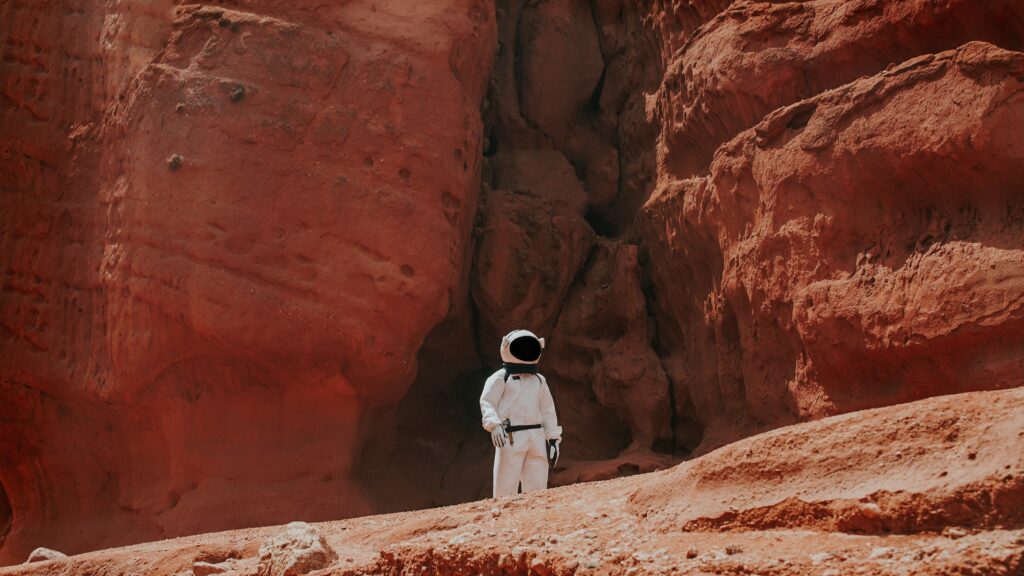
To compound these inhospitable conditions, Mars has no global magnetic field. On Earth, our magnetic field is what keeps us safe from dangerous space radiation and allows us to walk freely on the surface without protection. On Mars, to be on the surface, you would need a state-of-the-art spacesuit to keep you safe from the radiation and the poisonous air.
What will you eat?
To have a sustainable colony on Mars, it is important to grow your food. Any food brought from Earth will be stored as emergency rations.
The Martian diet will probably consist of three food groups: plants grown in your base under artificial light; insect products and cellular agriculture.
In recent years, astronauts have had successful vegetable gardens in space, growing basic things like lettuce, tomatoes and peppers. These are a good source of vitamins and nutrients. However, to feed a larger number of people, it will be important to farm vegetables that are denser in calories such as corn, wheat and soy.
Insects might sound like an unappetizing food, but around 2 billion people on the planet already eat them as part of their diet. They are a great source of protein and are very sustainable: insect farms do not require large amounts of land nor lots of water, like many contemporary farming practices.
Cellular agriculture is a very new type of food but is one that should be widely available and highly researched by the time humans first set foot on Mars. It works by extracting cells from a type of animal, then growing them in a nutrient solution. This can be done in big steel tanks, much like how beer is brewed. This is another very sustainable source of food and a much more ethical way of getting animal protein without raising and farming animals in harsh conditions.
Hobbies and Entertainment
You may be busy with farming and the general upkeep of the base, but like everyone, you need to have some fun! Activities could include sightseeing places like Olympus Mons, the largest mountain in our solar system, or even catch a bit of history and visit some of the oldest Martian rovers scientists have sent out.
Stargazing will be stunning, with new moons to gaze at and a clearer sky due to a thinner atmosphere and lower light pollution.
Live communications with home and luxuries like streaming services are a no-go, unfortunately. A message sent to Earth takes around 15 minutes to get there, then another 15 minutes to receive one.
Finally, with the low gravity on Mars, and your new superhuman jumping abilities, sports like basketball could be a lot of fun!
I hope you enjoyed your stay on Mars. See you next time!
Finally, with the low gravity on Mars, and your new superhuman jumping abilities, sports like basketball could be a lot of fun!
Our need to travel to Mars may be driven by the deteriorating condition of our planet. Check out these posts about the Bhopal Gas Tragedy and the Greenwashing tendencies of climate change actors to give some insight as to why the future of life on Earth could be limited.